Showing posts with label Women. Show all posts

Tuesday, December 30, 2014

A Lesson in Spotting Rhetoric

            I started this conversation last week by discussing Plato's anti-rhetoric stance.  Ostensibly I was writing about Phaedrus, but I mostly used it as a jumping-off point.  To be clear, in the Phaedrus, his position does seem more complicated than in some other dialogues like Gorgias.  His message in Phaedrus seems to be that he himself is having a hard time determining whether philosophy can ever be done without any rhetoric at all, while imploring us all to be very, very careful about how we allow rhetoric into our minds and lives.
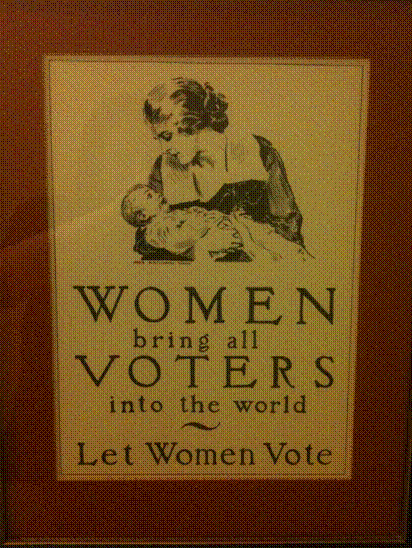
            An easy way to learn to spot rhetoric is to look at the pro-/anti- propaganda for something that feels obvious.  (Er...one hopes.)  For example, take a look at some of the posters supporting and opposing women's suffrage.
            The message of the first three is fairly simple:  women are supposed to be doing their work in the home, and giving them the right to vote will up-end that.  Suddenly, men will be saddled with all the baby feedings and the cleaning and so on.  I must admit, I rather like the second one; a pity having the right to vote doesn't mean I get to sit around eating chocolate and playing cards with my friends all the time!


            One of the things that feels obvious about these now — and that I think this next one particularly well illustrates — is that now the images feel grotesque in their literal role reversal.  The crude, almost oafish simplicity of the reversal makes you uncomfortable when you realize how natural the reverse of the images felt to the audience.  In other words, it felt totally appropriate to the anti-women's suffrage movement to simply place one of the women in the other room doing the washing, while there were three men sitting around playing cards.  (Presumably drinking beer rather than eating chocolate.  Beer if very masculine.)  I particularly enjoy "Husband's Working Hours 3 A.M. to 12 P.M."  Because those actually are most mothers' working hours.


            The message of all three is:  don't mess with the natural order of things.  If you do, women may very well take their revenge for all those years of oppression.


            This last one is interesting to me because of how complicated it is.  I think it's a valid point how many roles in society women were considered fit to serve in, while the vote was still denied to them.  And I like that "Mother" is included with "Doctor or Teacher."  On the other hand, the list of things "a Man may have been, & yet not lose the Vote" seems problematic.  "Unfit for Service"???  Seriously?  Because a guy is born with a congenital birth defect, or he's been injured in adulthood, his right to vote seemed questionable to these folks?
            And the one that says "Proprietor of white Slaves"...that one's interesting because it links up to a moral panic about "white slavery" — i.e., the kidnapping and forced prostitution of white women.  As it turns out, the panic was largely overwrought; there really weren't hundreds of women a year being forcibly dragged into prostitution.  The situation was tragic, but in a much different way.  There were hundreds, if not thousands, of young women moving to cities with no idea how to conduct themselves in a romantic or sexual relationship in a supposedly Brave New World.  Their parents were terrified a Jew or an Italian would seduce them into slavery, which was a red herring; what might have been useful was an actual education for young women on how to handle modern relationships.  But of course, their parents had no more knowledge about such things than they did.
            The scare over white slavery seems to have contributed to women getting the vote.  Suffragettes — many of them being mothers — were understandably scared about what they were hearing about their daughters in the cities.  They believed that getting the vote would empower them to put issues concerning sexual exploitation on the dockets of politicians.  It's interesting that a hysteria surrounding an only sort-of-real problem is part of what led to women's suffrage.


            The funny thing about a lot of the pro-women's suffrage propaganda is that it appeals to the same norms that are held up in the anti-women's suffrage propaganda.  They proclaim:  women want to do nothing but clean and make babies.  It's just that, politics do actually impact how we do those things, so we should get a say in politics.  The first two below actually affirm the proper place of women, and what kinds of work we should expect from them.  The message seems to be:  don't worry.  It won't be that bad.  Women will still take care of your kids!
            Of course it is true that politics do impact things related to women's work — everything from the ingredients in laundry detergent to breastfeeding in public to gun control laws — but because most of us feel like the statement "WOMAN'S JOB IS THE HOME!" is out of joint with our current time, the appeal feels off.


            The image below alludes to the white slavery panic I mentioned above.  It also uses a great image of a central female figure.  Yes, she's pushing for the right to vote, and that may seem to question the normal division of labor according to gender.  On the other hand, the figure, which is called "Womanhood," resembles a goddess or statue of an abstracted value — Liberty, say, or Justice — which is an interesting strategy.  It doesn't follow the lead of the above propaganda, which says, "Don't worry!  Women really want to stay home and have babies!  They just also want to vote."  It also doesn't suggest a wholly new way of looking at women (which would seem inappropriate; as voting wasn't new, agitating for women's suffrage was hardly a radical notion).  Instead, it reminds people that there are other narratives/images/archetypes for women within the context of the history of the West.


            This last one is just delightful.  Because they've simply adopted the rhetoric of the anti-women's suffrage movement to create a parody.  It does a nice job of showing how you can use language to argue just about anything.  Which is, again, Socrates'/Plato's definition of rhetoric.
            My particular favorite is number four:  "Because men will lose their charm if they step out of their natural sphere and interest themselves in other matters than feats of arms, uniforms and drums."
            Abso-fuckin'-lutely.  I might add soccer in there.  Or would that qualify under uniforms?


Monday, November 11, 2013

φιλοσοφἰα, γυνἠ, part two

Continued from an earlier post, on October 18th.


I'm spending awhile explaining where I'm coming from (in case that wasn't obvious from the aforementioned post). All of this is a very long-winded way of announcing that I am planning on moving into more explicitly philosophical territory. Philosophical, as I define it. I'm explaining my interest on a more personal level, because on the surface the term "Philosophy" comes off as specialized and, frankly, elitist. But the term, and the action of the heart and mind are, I think, very different.

            Philosophy is a word for something I originally turned to out of alone-lonely.  But then I got distracted from it by sex, and found a new kind of lonely:  I call it "man-lonely."  Lots of women know this lonely.  It's not so much wanting men, as it is the discovery that you don't get to choose either to be with them, or to escape them.  It's men who refuse to leave you alone, and even being a bitch just gets you followed around and yelled at for being a bitch.  (Trust me; I experimented.)  Alas, in my desperation to make the alone-loneliness stop, I mostly failed to be a bitch and went for super-sugary-sweet-and-nice and I held onto those assholes, goddammit.

            Fast-forward several years, and several miserable relationships later.  I am in a bookstore.  There's a book with a lovely cover.  It's called Philosophy, and I think to myself, "I remember when I used to like philosophy.  Before I dated men who like philosophy.  I remember when I thought I was smart.  Before I dated men who corrected me."  And I buy the book.  Mostly because the cover is nice, the layout looks like it's meant for laypeople, and the editor's name is pretty:  David Papineau.  The number of books I've purchased for similar reasons, and then never read, is huge; so I figure this one will have friends.

            One week after said book purchase:  I got in an accident.  My beloved Vespa betrayed me, crushed my foot, and removed a noticeable portion of my epidermis.  I was unable to walk for three months.  Suddenly, I had a lot of free time on my hands.  I couldn't fill it with work or men or anything.  Mostly I alternated between crying over my broken heart (I had also just been through [what I sincerely hope will be] the breakup to end all time), and crying from the physical pain I was in.  So what was I going to do with all my time?  I mean, I'm a champ when it comes to sobbing, but even I was getting tired of it.  Hobbling around on crutches was excruciating for reasons I won't go into due to the ick factor, so I basically had a forced three-month-long reading break.
            So there was this book.  And it was pretty.
            And I felt sick.  Sick from trying to crawl away from myself — from my own intellect and creativity — in an effort to be less intimidating to the men I was sure wanted to make me happy.  After all, they kept saying so!  "All I want is to make you happy and take care of you."  I'm pretty sure I thought that if only I could crawl fast enough away from myself, some guy would finally be able to give me all the love and happiness they kept promising.
            Which leads me to the second Greek word in the title of this post.

            γυνἠ: gunē.
Woman.
Because, finally, it is beginning to sink in: no human being can simply set aside their specificity in order to engage with the upper echelons of creative and intellectual achievement. I used to believe such non-specificity was possible. As a German-American who grew up surrounded by Jews, I was desperate for non-specificity. As a white girl who briefly lived in a part of California where I was one of the only white kids, I've been shocked to discover that most white Americans don't grow up with nearly the ethnic consciousness I always had. If you are one of those white Americans, I guess you're lucky. I guess that's what we mean when we talk about privilege.
When I was at university, and anti-feminists insisted that anyone was welcome to the philosophical tradition, that anyone could engage with the Western literary canon, everyone was welcome, it was an open book available to all, if only those women/blacks/Jews/gays/Latinos/whoever would stop whining about their differences for long enough to engage with the tradition, we could all realize how much we all had in common — I wanted to believe them so badly. I did believe them. I chimed right in.
But when I was finally angry enough at the way men had treated me, angry enough at the story of boy meets girl, boy loves girl, and they get married and he takes care of her for the rest of her life, when I was finally angry enough to have not only been lied to, but to have helped build the lie, when I was finally angry enough to push back, I can tell you specificity still mattered.

So here we are. For the past year or so, I've been reading Plato. Almost nothing but Plato. And, um, why is this blog here? Oh, yeah. It was supposed to be a space for me to think out loud about what I was reading. But honestly, I haven't been thinking out loud about a lot of what I'm reading, because I keep having all these thoughts that seem — *ahem* — specific. They are specific to being a woman, and specific to a post-colonial historical moment. They are specific to being a German-Scottish-French-American, and therefore both supposedly part of the tradition by ethnic descent, and awkwardly insecure about where our rebellious, anti-aristocracy, money-obsessed colony fits in with that tradition. And maybe more than anything else, my thoughts are specific to being an uncomfortable-yet-still-devout Christian, which is so incredibly out of fashion in philosophical circles as to silence all but the most confident (or naïve) thinker and writer.
Nothing I'm saying here is exactly new. Feminists and queer theorists, at the very least, have been saying it for at least a hundred years. But after all the miserable relationships, and confused and confusing teachers, all the Hollywood movies I believed without knowing I believed them, something even better than the bookstore happened: I suddenly found several men in my life who are probably better feminists than I am. They seemed to believe in the value of my thoughts and creativity, and also (to my surprise) were pretty sure I should be pissed off at having been silenced in so many ways, some subtle, some not so much. Like, spitting venomous, fire-breathing unicorns kind of pissed off. Maybe I should have been able to get there on my own. Maybe I should have been inspired by a feminist or two. (Okay. Maybe one. Or two.) But however it happened, it happened. I got lucky. I found out that the issue with men and women in this world isn't that men are mean and women are pure and innocent victims. It's much more complicated and difficult and interesting than that.
So while it's true that nothing I'm saying here is entirely new, I think I got tired of not saying it, in my own words.

Friday, October 18, 2013

φιλοσοφἰα, γυνἠ, part one

            φιλοσοφἰα
            Philosophia.  The original meaning is "love of wisdom."  That's a lovely original meaning.
            I go back and forth on the term "philosophy."  For now, I am happiest with the phrase, "the life of the mind."  Philosophy has started to sound so cold, and what drew me to the life of the mind (originally) was much, much more personal.  It was an aching loneliness, that started sometime in grade school.
            So here, for the next two or three posts, I will stories centering around two different words.
            First, a chronology.

            Long time ago:  Somebody writes the fucking book of Genesis, which is one of the better pieces of literature.  But strange once you read the really old creation myths.  In which the reader discovers that most of humanity believed that the world was created by a goddess and a serpent, and the whole dude thing didn't show up until much later.

            Approximately 1933-1945:  Shoah, or the Holocaust.  Or the really brilliant PR concept, the Final Solution.  During Shoah, probably around 6 million Jews were killed by Nazi programs in and around Germany.  If we broaden to "the Holocaust," and include in that all of the religious dissenters, homosexuals, Romani, disabled, and other lives deemed unacceptable by Germany, the number rises to about 5 million more humans, for a total of approximately 11 million people dead.

           1991:  I started attending the public junior high in Mercer Island.  I lived on Mercer Island, but until then my mom had driven me to another nearby town to go to a small Christian school there.  Because I hadn't been going to the public schools where I lived, I hadn't known much about the demographics of my own neighborhood.  One of my first discoveries was Jewish kids.  Lots of Jewish kids.  I was initially thrilled to discover that the Hebrews of the Bible had survived in the modern era.  I had thus far believed them to be extinct because we always talked about them in the past tense in church and school.
            I was, however, quickly apprised of the events of the Holocaust.  Being raised in an Evangelical home and church, with a heavy emphasis on guilt, and being mostly German American, the results were fairly predictable.  Not least because — and this itself was probably due to the historical influences on Mercer Island's ethnic composition — everyone my age was obsessed with ethnicity.  When you were meeting a peer for the first time, you would exchange names, ages, and would immediately be asked something like, "Where is your family from originally?"
            If I'd had any sense, I would have said I was Scottish.  My last name is Scottish.  But I am predominantly German, and compulsively honest.  So when the inevitable, "What ethnicity are you?" came up, I couldn't stop myself from saying "German."  The responses were less than favorable.  Usually it was just a quiet "Oh," and they would suddenly be not interested in being my friend.  Once, I got a horrified, "You're a Nazi."  Luckily even then I saw some of the silliness of this.  (Some.)  But it didn't change the fact that my family's origins shaped my whole social experience of junior high.  And, perhaps most importantly, I knew it.

            What got me interested in philosophy — probably between the ages of thirteen and fourteen — was neither the supposed topics, nor any interest in a method of questioning.  It was weirdness.  My weirdness.  Weirdness, and its requisite alienation.  It was being an outsider, having no friends to eat lunch with at school, and every time I did try to talk to my peers I was terrified by how casually they seemed to take life, and how seriously I took it.  You could call it being uptight, on my part.  And also, loneliness.

            At the church I went to in high school, the pastors were fond of expounding on "the roots of words."  These were mostly botched attempts, which frequently conflated the history of the form of a word, with the history of its meaning.  The word "sin" is a great example of this.  Or the etymology of a word — say, "woman" — would be used the prove the accuracy of the same ideology which gave rise to the word in the first place.

            Eventually, in college, men discovered me.  The supposed consolation of human companionship was mostly supposed; still, I was distracted from philosophy, from my newly discovered smarter-than-thou status, and thought I had found a cure for my isolation:  sex!
            Still the loneliness continued, and I discovered many of the real reasons so many women are suspicious of men.  And being intellectual does not help.  Most intellectual men want a woman who will "Ooooh" and "Aaaahh" to their fascinating observations, and less intellectually oriented men seem to resent the idea of a female companion being smarter than them.

            Philosophia is a beautiful word, with an important original meaning.  These days, it feels like a word for something out of reach.  Every time I use the word "philosophy," I feel like I'm in a Monty Python skit and the skies should pop open with a booming voice:  PHILOSOPHY.  I dig Monty Python, but such antics make me feel awkward and unfunny.  Not so much inspired to join in the conversation.
            But this feeling isn't an accident.  It would appear that the only way to get called a "philosopher" is to go to a university and get a doctorate.  Now that is a very, very expensive way to read books, write papers, and sit around discussing them both.  But academicians keep encouraging us to view philosophy as a highly specialized field, because why else would anyone be willing to spend that kind of money or, more realistically, take out loans they'll be paying off for the next thirty years?
            It remains to be seen if this trend will change for the better anytime soon.  I am encouraged by a lot of what I hear/read going on outside of the academy; for example, at Partially Examined Life* and at Philosophy Bites**, whose own Nigel Warburton recently left the academy because he isn't so sure it's the best place to do philosophy anymore.  But I'm not convinced this exactly heralds a sea change.  Both Philosophy Bites and Partially Examined Life focus almost exclusively on responding to the same people and topics that are dealt with in the academy.  It's not that I think the academy has it wrong about the importance of the philosophical literary tradition and its foci.  It's just that I'm not sure when we can expect to see non-academicians coming up with original, well-articulated ideas that are taken seriously enough to make it to some kind of larger discourse.  Unless/until that happens, it seems we are stuck with the academic model, both in terms of what subjects are discussed, and which interlocutors are taken seriously.


*  Which is awesome, by the way.  Totally worth checking out.
**  Which is also awesome, and much more succinct.


Saturday, October 5, 2013

Tugging and Prying, in its Subtler Forms

            Thoughts on Chapter 10 of The Artist's Way.  Part ten of twelve on creativity.

            Humans (I'm told) are a social species.  I happen to be human.  Also, I'm a heterosexual and a woman (or maybe cis female would be a little more accurate), and these aspects of my social identity have contributed significantly to shaping me into someone who is nigh-on obsessed with social cues and norms.
            I've been on two silent meditation retreats now*.  Both were only five days long.  On neither of them did I achieve anything like the blissful state of calm I hear so many people describe.  I was definitely calmer by the end, but mostly that just made me realize how hopped up I am for 99% of my life.  And I have a pretty good guess what I'm hopped up on:  socialization.  Not because I like it.  I hate it.  I would almost go so far as to say I hate humans, if I wasn't afraid of alienating my readership.  (God how I aspire to having whales who would take my work seriously.)  But think about it.  This whole smile, make eye contact, then listen and talk thing is beyond exhausting.  I don't know how I manage it.  Because on both of my silent retreats, I spent the whole time on one loop:
            "Oh, no!  Should I have held the door/waited for him to take a bowl first/left my shoes outside/done my hair better/been quieter when I moved my eyeball?  They must be so irritated with me!  I'm sorry!  I'm so, so — Oh, wait!  We're in silence!  No one cares what I do!  I can relax!!"
            I relax for five seconds.
            Then, "Oh, no!  Should I have..."
            That is how I spend my life.  And I will go out on a limb and say that I suspect it is how you spend a large portion of your life, too, whether you're conscious of it or not.  Because I had absolutely no idea how I spent most of my life until I went on a meditation retreat and discovered that my universe turns on the axis of what people think of me.
            Obsessing about social cues, pressures, and norms looks different on different people.  I think it's important to realize that always pushing against the norm is still a way of defining oneself according to the norm.  Two of the many little boys in my life were recently discussing this with me.  Keshav, the elder brother, pointed out that his younger brother could be pretty easily manipulated by using reverse psychology.  Just say, "Ishaan, you better grab my car!  Or else!"  And, presto!  Ishi will stand defiantly over the car refusing to touch it for the rest of his life.  So I asked Ishi what was going on when people told him to do things.  He couldn't explain it (he's four years old, so such an explanation is probably a couple of years away), but he affirmed that no matter what, he always has to do the opposite of what he's told to do.  When I asked Keshav how he feels when grown-ups give him instructions, he got wide-eyed and a little serious and said, "Oh, I do what they say."  He also couldn't explain why; he just said that he felt like he really needed to do what the grown-ups told him to do.
            As Keshav's observation about manipulability demonstrates, Ishaan doesn't free himself by being so contrarian.  Both boys are making decisions, and the opinions of grown-ups weigh heavily in the scales.
            In Week 10 of The Artist's Way, Cameron discusses some of the most common blocks that people turn to in order to stifle their own creativity.  Two of them, erm, rang a bell with me:  relationships, and their best friend, sexuality.  I'm using the term "sexuality," and not "sex," because I'm not really talking about coitus.  I'm talking more about the mating game.  The relentless energy drain that is worrying about the bloody opposite sex/sex of interest.**
            When combined with the myriad other subtle pressures to smile, dress appropriately, not raise your voice in public anywhere ever on the West Coast, and rave about Mad Men/Breaking Bad/Walking Dead/insert popular show Leigh either despises or knows nothing about — these things add up.  As in, get heavy.  Get heavy and occupy the almost immeasurable quantities of mental energy we have, and never know we have, because they are always preoccupied with the things we're not conscious of.
            There's another trick to beware of here:  as soon as we hear the phrase "sex and relationships" we lie to/console ourselves by saying that's just a part of our life.  Like, somehow we compartmentalize sex and relationships (both the sexual and the non-) into these little, well-controlled sectors and don't let them interfere with the really important stuff.  This attitude is dangerous for at least two very obvious reasons:  it denigrates relationality/sexuality, by making them into distractions from the supposedly important stuff; and secondly, it's just not true.  You — the mass of creative, spiritual, intellectual, physical, and mental energy that you are — you are relational.  In other words, your relational and sexual qualities are not just a couple of the compartments, like intellect and physicality.  (The debate about the above list and which parts of it constitute "parts" and "wholes" will have to wait for another day.)  The you that is you is not even exclusively one you; it's a part of a whole.  By definition.
            The problem when you're talking about creativity and this relational aspect of us humans, is that frequently they directly conflict.  For one thing, there's time and energy.  Everyone in the world thinks they have a claim on your time, whether you've met them or not, and that goes about ten times over for women.  But beyond that, there's the weird, insistent tug that relationality exerts on our psyches.  You can kick everyone out of the room, for an indefinite period of time, and yet you know they will keep prying into parts of your head, the subtle desires and fears of approval and rejection, the obligations will never relent even in your own goddamn head.
            And of course, do you even want to kick everyone out of the room?  I, for one, do not.  I actually love some of those weirdos and wallflowers, and some of the rest I can even stand with measurable pleasure.
            But if I'm supposed to be writing about creativity (which I am), I have to say:  sometimes you gotta kick those guys out.  Like, everyone.  Everyone, even at the risk of making some people mad.  Even at the risk of making some people not like you, which is terrifying.  Even at the risk of kick them all out, to attempt (and fail) to clear some head space, so you can attempt to make an artifact that you will look at afterwards and know immediately:  it's a failure.
            Still, I stand by it.  Sometimes, you gotta kick those guys out.  Even the best of them.  Because not one person who has a claim on your love, affection, time, energy, interest, etc. — not one of them can live your life, can make the things you can make.  Not one can give you back that time later on so you can finally get to the work you've always been meaning to get to.


*  The silence of a meditation retreat is often called Noble Silence, and it means more than just not talking.  It means not talking, but also not listening in if/when you hear others talk, not reading or writing, and (blissfully) no eye contact.  No eye contact!!!   NO EYE CONTACT!!  That is what heaven is for me.  An eternity of being left alone.

**  Okay, so I assume heterosexuality when I say "opposite sex," and I'm not totally happy with the replacement, "sex of interest."  But for now, it's what I've got.  If someone could suggest a term that includes both opposite and same sex objects of interest and torment, please do.

Tuesday, January 8, 2013

Identity, Artistic and Otherwise

            The title of the second chapter of The Artist's Way is "Recovering a Sense of Identity."  So I guess this is part two of twelve on creativity.


            Most of the time I distrust the idea of identity.  Identity feels like a trap.  You tell yourself, "I'm the sort of person who..." and then you re-enact a behavior over and over again.  Say, I don't know, hurling yourself at romantic partners before knowing whether or not they have your best interests at heart.  (I know nothing about that.)  Then, when you decide you don't like the behavior's consequences anymore, you have to undo a sense of identity.  No small task.  But let's just say you achieve it.  You actually manage to change your deepest ideas about who you are.
            Congratulations.  Now you say, "I'm the sort of person who..."  Doesn't trust people?  Or, no, waits to get to know people really, really well and analyzes them with a therapist for years before you display any affection?  But now, what about the negative consequences of this identity?  How long before you decide it's time to change identities again?  I'm sure the correct answer is that you replace your old, defective identity with a new, perfectly well-adjusted version; someone who never smokes or drinks too much and always communicates clearly.
            Please, please post in the comments below if you or anyone you know displays these supposedly functional behaviors.
            "I am like this and this.  I am not like that or that."
            It's a curious mixture of reflection and willful ignorance.  To say that I am the sort of person who...jumps a little when I hear an ambulance siren...is to say that I have observed my body reacting a certain way when I hear an ambulance siren.  But rather than saying, "I notice that my body jumps a little when I hear an ambulance siren," I say that "I jump a little when I hear an ambulance siren."  Also, this particular reaction (which I've observed in myself since my accident this past summer), is really quite short-lived.  There's no reason to think that I went 32 years without displaying this behavior, and now it's suddenly a permanent part of who I am.
            I want to refrain from trying to sound too Buddhist here, mostly because I don't know enough about Buddhism to be more than a dabbler at this point.  But I will say that after relatively little experience with meditation, I'm pretty sure that 99% of who we think we are is made up.  Not just made up by us, either; made up by our societies, our families, our teachers and lovers and friends.  And perhaps more powerfully, by the gaps in our lives where those people should have been.
            At the same time, I notice that consciously working on a sense of identity can be extremely helpful as a writer.  American culture is none too kind to its artists, and to a certain extent you sort of have to repeat over and over to yourself that you're an artist, or poet, or composer, or whatever.
            But the catch is, I think, that it's only a starter.  I have been, since I started the Artist's Way this past summer, diligently returning again and again to affirmations.  I struggled with them initially, feeling they were corny, but then settled on a nice compromise with myself:  I never "affirm" anything that isn't true.  So, while Cameron at one point suggested writing something like "I am a prolific artist," I couldn't live with this phrase because even in my best moments I am not prolific.  If a female rabbit can theoretically produce as many as 800 children, grandchildren, and great-grandchildren in a single reproductive season (!!!), a female blue whale is more my pace:  one baby whale every two or three years.  I can't remember exactly what the phrase I settled on was, but I went with something like, "productive."
            But then, what if I'm ever not productive?  Given that I'm a woman of still-re-productive capacity, a several-year-long distraction might be in my future.  At that point, since I think it's silly to say things which aren't true, I guess I could just say to myself, "I'm open."  Can I affirm I'm a poet at that point?  Is it helpful to do so, when I see myself failing to live out the identity I'm insisting on because Julia Cameron told me to do it?
            I've mentioned baby-making a couple of times here, and I suppose it's on my mind.  Because in all honesty, if I ever do take that particular leap, I would like to set aside my "poet" identity for a little while.  It seems like insanity to be nursing a newborn and dealing with things like colic and ear infections and sleep problems and (I assume) a rapidly deteriorating romantic relationship while trying to write inspired poetry.  Maybe it would be better to stick to "mom" and hopefully "decent partner" for a little while.
            But can you set aside your identity like this?  So much of who I am seems to have been waiting for me at birth:  caucasian; female; introverted; intellectually driven (and distracted); heterosexual; American; even Christian, to a certain extent; and on and on.  Can I set aside being a poet?  In my experience, my inspiration makes me miserable every time I try to set it down, and this makes me wonder if I'm entirely wrong in thinking identity is self-made.
            Vocation is a lovely old word, a very Christian old word, and one I like very much.  "Spiritual path" conveys the same sense, but I think my agnostic and atheist friends have a vocation to reject everything I believe in and they'd bristle to hear their work referred to as spiritual.  (For all I know they'd bristle to hear me call their convictions a vocation; I beg them to extend Christian forgiveness to me.)
            Vocation means "calling."  As in, someone called you.  Presumably, someone who is not you.  All I can come up with when I look at Samuel is that maybe when the soul says, "Here am I," it doesn't get to know the path beforehand, doesn't even know the identity it's been called to.

Monday, November 19, 2012

Daniel Craig and the Modern Bond

            I hereby dedicate this post to stating how much I love Daniel Craig.
            So yes, I am moving from The Pilgrim's Progress and discussions of reformation Christianity to James Bond, beautiful blond men, and movies in general.
            This past weekend I saw the new Bond movie, Skyfall, with the *sigh* gorgeous Daniel Craig.  I have seen a number of Bond movies, including all three of the Craig films, as well as most of those which Sean Connery starred in.  I haven't been keeping up on my internet reading, but I know I am not the first to draw comparisons between Craig and Connery's versions of Bond.  Sean Connery was always my favorite, until Daniel Craig came along, and I admit to having been somewhat surprised at Craig's casting and unsure as to how it would work out.
            This brings me to the first quality Craig brings to Bond which initially struck me as perplexing, but which ultimately I find much more satisfying to modern audiences:  brutality.
            Connery as Bond was always and forever suave and in control.  He moved with elegance, and seduced women with absurd ease.  Daniel Craig, however, is an entirely different man.  I suspect a great deal of Craig's brutal aspect has to do with his physical appearance.  He is stocky, extremely muscular, and while he does clean up nice in a tuxedo, his shortened and springy gait belies the surface of smooth decorum.  Certainly this is part of his appeal, in particular sexually.  Sean Connery appears to be the sort of man who makes love.  But a woman feels quite certain that Craig would (please excuse me, but I can't think of any other way to say it) fuck her silly.
            But as any person who has seen Craig's Bond will know, he also brings a vulnerability to the character which is at strange odds to Bond's necessary callousness about killing.  While there is a great deal of casual sex, Craig's bond seems to occasionally make the mistake of caring about some of the women he sleeps with.  And while I know I'm confusing fact and fiction here, I cannot help but see the fact that Craig sliced off the tip of his finger while shooting Quantum of Solace as symbolic.  To me, Craig is intent on making Bond both darker and more believable, a combination which almost always results in a far deeper connection between character and audience.  I never for a moment believed Sean Connery's Bond would get an owie; Craig, one worries, might well end up dead.  Christian Bale in The Dark Knight also comes to mind here.
            The weird juxtaposition of these aspects is brought out, in Skyfall, with Bond's brief encounter (and requisite shower-scene) with Sévérine.  When Bond meets her, he notes her tattoo, showing her long-ago abuse in the Macau sex trade.  He points out she must have been forced into the sex trade young, perhaps twelve or so, and that in seeking to free herself from one oppressive system she has made herself the victim of a sadistic man, Raoul Silva.  Bond offers to kill her employer if she can get him to the man.  All of this seems to indicate that Bond feels at least some sympathy for Sévérine.
            Later, however, Bond's empathy seems to have been false.  Silva has Sévérine beaten by his henchmen, and then carefully places a glass of 64-year Macallan on her head and invites Bond to shoot it off.  Bond misses the shot glass (and her head), after which Silva intentionally kills Sévérine; but Bond's only response is that it was a waste of good scotch.
            For me, the fascinating aspect here is that the contradiction within Craig's Bond is lodged there by necessity.  His brutality fits perfectly with our forever-escalating political violence, which itself belies our supposed concern for abused women.  Even now, drones are killing women who might very well be every bit as beautiful as Bérénice Marlohe, and even some less attractive ones we might be able to find it in our hearts to care about.  This is the world we live in, and it is the world of espionage which the modern Bond films try to inhabit.  Craig has, in my opinion, been instrumental in situating them here, and not in an imaginary world where the greatest threat is the disruption of a rocket taking off into outer space for safely unbelievable reasons.
            Craig's vulnerability also seems to bring him more into the modern world.  But then again, the Bond movies clearly depend upon tropes and clichés to convey meaning:  the unreachable heights of wealth; the gorgeous and exotic locations; even Bond's insistent egotism and somewhat tired jokes are needed.  And right along with these tropes are the women, who are themselves a kind of cliché.  But there is a problem here for modern audiences; on the surface, we find it less acceptable to dispose of women without any sense of empathy or justice.  Hence the modern touch about the sex trade, Marlohe's highly believable portrayal of a trapped and terrified woman, and Bond's eventual capture of her killer.
            Still, Bond is essentially a hired assassin, though he might be hired by a nation we currently have as an ally.  But Daniel Craig's interpretation of Bond, and the clichés upon which the Bond movies depend, hold a fascination which I look forward to seeing for two more films.

Wednesday, July 4, 2012

Vocation and (Women's) Work


“To be true to one’s calling, whatever follies one might commit in one’s emotional life, that was the way to spiritual peace.”  Dorothy L. Sayers, Gaudy Night.

            Gaudy Night is a mystery novel by Dorothy L. Sayers featuring her famous detective hero Lord Peter Wimsey and Wimsey’s love interest, Harriet Vane (incidentally the Harriet of the blog’s title).  Harriet is, like the real-life Sayers, one of the earlier women to have graduated from Oxford, and there is a fascinating discussion towards the end of the novel on academic ethics and principles.
            The College Dean has mentioned a novel in which one academic discovers that another professor has deliberately falsified data in order to obtain his position at their university.  The man who discovers the truth, however, reveals it to no one, “because the other man is very badly off and has a wife and family to keep.”
            This is a group of female professors, discussing whether truth, and loyalty to truth, can and does come before considerations of family, financial obligations, etc.  It should perhaps be kept in mind that, at the time Sayers wrote this novel, there was still a very prevalent belief that learning somehow “turned” women’s heads.  In other words, rendered them unnatural; unnaturally callous towards children, husbands, and so on.
            The Warden presses the point:

            “A false statement is published and the man who could correct it lets it go, out of charitable considerations.  Would anybody here do that?  There’s your test case, Miss Barton, with no personalities attached.”
            “Of course one couldn’t do that,” said Miss Barton.  “Not for ten wives and fifty children.”
            “Not for Solomon and all his wives and concubines?  I congratulate you, Miss Barton, on striking such a fine, unfeminine note.  Will nobody say a word for the women and children?”
            (“I knew he was going to be mischievous,” thought Harriet.)
            “You’d like to hear it, wouldn’t you?” said Miss Hillyard.
            “You’ve got us in a cleft stick,” said the Dean.  “If we say it, you can point out that womanliness unfits us for learning; and if we don’t, you can point out that learning makes us unwomanly.”

            I don’t know why this novel has been on my mind, lately.  I find something both deeply comforting and disturbing about Harriet’s view, which is encapsulated in the opening quote:  “To be true to one’s calling, whatever follies one might commit in one’s emotional life, that was the way to spiritual peace.”
            Personally, the sentiment comforts me because I identify so strongly as a writer and it seems that no one can take that away from me.  Other desires that we have – and this of course includes many, many men in it as well – for instance to have a marriage and a family, a stable home for some, a well-knit community for most of us…  In a sense these are vocations over which we have very little control.  Devotion to work seems in some ways so simple
            But these other works – long-term relationships, children, stability, community – you can hurl yourself into them all you want, and simply have them not work out.  Your spouse might leave you, you might not be able to have children, you might be unfortunate enough to live in the community-starved United States, whatever.  Harriet’s thought is comforting, because insofar as the artist or scholar prioritizes their work, which is less susceptible to others’ whims and emotional variations, they can withstand these trials because they have something larger to devote themselves to.
One detail I find interesting here is that the work traditionally allotted to women seems to me the more unstable work because you need particular people there to do it for.  Though the Roman Catholic Church officially recognizes marriage as a vocation for both sexes, I would argue that most of us don’t tend to look at being a husband as a “job.”  It is something which good, dependable men do, and the women are lucky if they find someone who is faithful, or at least talented at covering up his infidelities.  His work is elsewhere, outside the realm of family.  The women’s work is, traditionally and for many women today, the family.
            But maybe I’m taking too romantic a notion of vocation here.  After all, most moderns don’t seem to have any vocation other than that of family and friends.  I would hardly ask anyone to regard being a financial analyst or an office manager as a vocation.  Isn’t it simply a job?  A person does their job, and then gladly clocks out to go and live their real life.  A nice clean separation between the thing you do to make a living, and the things you would rather be doing.
            Clearly there is often a distinction between the work we do to keep a roof over our heads and the work we take satisfaction in.  One pulls a paycheck; we can (and should) try to have a good attitude towards it, but aren’t we always happy to have a vacation?  The other is a band we’ve formed with friends, or the family life we are building, or whatever; this is the work we want to spend our vacation focusing on.  But here is the question posed by those Oxford women professors:  what if one unfits you for the other?  In other words, what if being a mother makes you unfit to be an intellectual and a scholar?  Or what if being an intellectual unfits you for being a mother?
            I hardly think most of us would believe this possible, but let me take this a little farther:  what if being a financial analyst or an office manager unfits you for your band/poetry/family life/etc.?  Doesn’t this happen?  I would argue even further that some of the so-called jobs we’ve created for writers and artists — such as being writing/art/music teachers and editors/curators/conductors — clearly unfit them for writing life.  What good can it possibly do an experienced and educated writer, who needs time and peace and quiet more than anything, to have to read and work with the fairly pathetic words of a bunch of undergraduate creative writing majors?  And how many editors keep writing at the end of the day, when they have effectively spent their whole day rewriting the works of others?
            Of course one can always try "to be true to one's calling."  Until confronted by the fact that one's emotional life (as well as its financial demands) almost forces itself into the center of your life, relegating the calling to the fringes.