Showing posts with label Feminism. Show all posts

Monday, September 7, 2015

Phalli, Vulvae, Thought: Part Finale!

            A note: I kind of, sort of apologize for all the Greek in this post. But not really. I'm ridiculously proud of myself for figuring out how to enable the correct keyboard, and I was pleasantly surprised to discover that my efforts at learning some Ancient Greek have enabled me to just barely type some of it without getting a headache. All poems/fragments are from Anne Carson's translation, If not, winter.


            I would be lying if I said I was satisfied with what of Sappho I have available to me. But...I sort of thrive on dissatisfaction. I am a poet before most things, and I no more want everything in the world filled out, finished, and explained with perfect clarity than I want to die and actually meet the God with whom I have such a robust, painful, and complicated relationship; meeting one's paramour is so often a disappointment.
            Still, what to do with poems who cling to life by the thread of individual words?

175 
αὖα          dawn
188
μυθόπλοκος          mythweaver 
179
γρύτα          makeup bag
172
ἀλγεσίδωρος          paingiver
But then, things happen in a poem fragmented by time and matter's dissolution:
105A
οἶον τὸ γλυκύμαλον / ἐρεύθεται ἄκρῳ ἐπ' ὔσδῳ,

ἄκρον ἐπ' ἀκροτάτῳ, / λελάθοντο δὲ μαλοδρόπηες,   
οὐ μὰν ἐκλελάθοντ', ἀλλ' οὐκ ἐδύναντ' / ἐπίκεσθαι
as the sweetapple reddens on a high branch

high on the highest branch and the applepickers forgot —
no, not forgot: were unable to reach
I really, really wish I could explicate the poem, and the incarnation we have at our disposal, as well as Carson. But I cannot. Here is what she has to say about it:
"The poem is incomplete, perfectly. There is one sentence, which has no principal verb or principal subject because the sentence never arrives at its main clause. It is one simile, whose point remains elusive since the comparandum never appears. It may be from an epithalamium, but it seems precarious to say so in the absence of the wedding party. If there is a bride, she stays inaccessible. It is her inaccessibility that is present. As the object of comparison suspended in line 1, it exerts a powerful attraction, both grammatical and erotic, on all that follows, but completion is not achieved — grammatical or erotic. Desiring hands close on empty air in the final infinitive, while the apple of their eye dangles perpetually inviolate two lines above." (Carson 1998, 27)
Perhaps the rest of the poem was gorgeous. Perhaps, had it survived intact, it would have altered the course of Western literature. Perhaps I am wrong to celebrate the magic in the interaction between the poem's words and images, and the brokenness of the body which managed to stagger its way out of time.

            In Republic, Plato uses three classes of citizen in his ideal state as an analogy for the human soul, where the warrior class stands in for the spirited part of the soul. The part which grows offended when someone has insulted or wronged you and will fight for your dignity as well as your survival. The part of you, in modern parlance, which watches out for your "boundaries."
            I don't put the word in quotes because I disparage it. Recognizing where I end and other people begin has been a major part of growing up for me. But then, is it essentially human? In hunter-gatherer societies, as well as in many more traditional horticulturist and/or herding societies, the individuals live in relationships which I think many modern psychologists would define as pathologically enmeshed. In fact, I think an argument could be made that the belief that I end anywhere is related to statism and capitalism: their methods of definition by literal delineation, by finitude.
            This conflation of the individual and the state was not Plato's innovation; at the very least, I know that the Pharoahs and the Hittite kings made a similar move in their rhetoric. But I don't know of any previous writer who went in Plato's direction: rather than the individual representing the state/kingdom in miniature, as it were, an entire city state was used to depict the complex of needs, hungers, drives, and dreams of the individual.
            The question of boundaries is paramount in erotic literature. Sappho calls Eros, among other things, λυσιμέλης: lusimelēs. Limb-loosener, or melter of limbs.
Ἔρος δηὖτέ μ᾽ὀ λυσιμέλης δόνει,
γλυκὐπικρον ἀμάχανον ὄρπετον
Eros the melter of limbs (now again) stirs me —
sweetbitter unmanageable creature who steals in
      (Sappho fr. 130)
 πόλλα δὲ ζαφοίταις᾽ἀγάνας ἐπι-
μνάςθεις᾽ Ἄτθιδος ἰμέρωι
λέπταν ποι φρένα κ [ . ] ρ . . .  βόρηται
But she goes back and forth remembering
gentle Atthis and in longing
she bites her tender mind
      (Sappho fr. 96)
Lobel and Page translate the last two lines "a hole is being gnawed in [my] vitals." Is this being-crossed-into desirable? Certainly, historically, it seems to be the very definition of desire. And when I come across it in my own life, I almost never say no. Is it pathological? Do we want to avoid pathology? And what of happiness? Because Eros seems very, very rarely to lead to happiness. Or at least, not the American version of happiness.
ὄπταις ἄμμε          you burn me (fr. 38)
ταῖςι ψῦχρος μὲν ἔγεντο θῦμος          their heart grew cold
πὰρ δ᾽ ἴειςι τὰ πτέρα                            they let their wings down (fr. 42)
Γλύκηα μᾶτερ, οὔ τοι δύναμαι κρέκην τὸν ἴςτον
πόθωι δάμειςα παῖδος βραδίναν δι᾽ Ἀφροδίταν 
sweet mother I cannot work the loom
I am broken with longing for a boy by slender Aphrodite
      (fr. 92)

The triangle is one of love poetry's most enduring formations. It allows for heightened complexity, heightened desire, but still maintains cohesion, still resists centrifugal disintegration. One of Sappho's most famous poems features a poignant triangle: the speaker*, a man, and a woman he is wooing. Its pleasure lies partly in the classical forces of the formation,** and partly in the way the poem tugs at the edges of the genders, the crosscurrents of identity, erotic lack, and social convention. Sappho paints a picture which is clear and vivid, but which also leaves vast tracts open for the reader/listener to slide in and out of the various characters.

Φαίνεταί μοι κῆνος ἴςος θέοιςιν
ἔμμεν᾽ ὤνηρ, ὄττις ἐνάωτιός τοι
ἰςδάνει καὶ πλάςιον ἆδυ φωνεί -
      ςας ὐπακούει 
καὶ γελαίςας ἰμέροεν, τό μ᾽ ἦ μὰν
καρδίαν ἐν ςτήθεςιν ἐπτόαιςεν
ὠς γὰρ <ἔς> ς᾽ ἴδω βρόχε᾽ ὤς με φώνη -
      ς᾽ ο᾽θδὲν ἔτ᾽ εἴκει, 
ἀλλὰ καμ μὲν γλῶςςα ἔαγε, λέπτον
δ᾽ αὔτικα χρῶι πῦρ ὐπαδεδρόμακεν,
ὀππάτεςςι δ᾽ οὐδὲν ὄρημμ᾽, ἐπιβρό -
      μειςι δ᾽ ἄκουαι, 
έκαδε μ᾽ ἴδρως κακχέεται, τρόμος δὲ
παῖςαν ἄγρει, χλωροτ έρα δὲ π οίας
ἔμμι, τεθ νάκην δ᾽ ὀ λίγω ᾽πιδε ύης
      φα ίνομ᾽ ἔμ᾽ αὔτ αι. 
ἀλλά πάν τόλματον, ἐπεὶ καὶ πένητα
He seems to me equal to gods that man
whoever he is who opposite you
sits and listens close
      to your sweet speaking 
and lovely laughing — oh it
puts the heart in my chest on wings
for when I look at you, even a moment, no speaking
      is left in me 
no: tongue breaks and thin
fire is racing under skin
and in eyes no sight and drumming
      fills ears 
and cold sweat holds me and shaking
grips me all, greener than grass
I am and dead — or almost
      I seem to me. 
But all is to be dared, because even a person of poverty
          (fr. 31)
________________________________________________________

            And for my next trick... I have no idea!! Which is glorious, because I tend to overplan by a mile. I usually have my next five to ten posts arranged in a neat little line in my head, so it's quite pleasant to be at loose ends. I've also been finishing a number of books — Carson's Eros: the Bittersweet, Saxon's Sex at Dusk (a highly satisfying, if somewhat disturbing, rebuttal of the shitty science and psychology of Sex at Dawn), and Alison Stone's An Introduction to Feminist Philosophy — all without starting any new ones. It's so strange to have space open in my head.
            I suspect there will be some more posts on poetry, simply because I've been in the mood lately, but I'm also trying to leave some openings for what I'll be studying in my upcoming classes. This month I start on prerequisites to go to grad school for psychology (with a heavy dose of theology, philosophy, and psychoanalysis), so I expect to have a lot of pleasurable thoughts colliding and exploding in my head in the near future. We'll just have to wait and see what makes its way in here.


* The tendency is to read the speaker as Sappho herself. This is in fact how I read the poem. With the exception of the very tiny fragments (which is actually most of her work), I feel like it is fairly easy to tell when Sappho is taking a "higher" tone — i.e., is composing for a wedding or other such occasion, and is therefore speaking with a persona which may be very different from her own — and when she is speaks from her own heart. I may very well be being presumptuous.

** My favorite triangle of all time being I Capture the Castle by Dodie Smith.

Wednesday, August 12, 2015

Phalli, Vulvae, Thought: Part 5

            It would be disingenuous of me — writing a couple of posts about Sappho at the end of a series on homosexuality/homoeroticism in Ancient Greece — to try to deny the power of the questions around Sappho's sexuality. Was she, or wasn't she? We want to know. After all, this is the woman who originates the term lesbian, a term which has no correlate amongst gay men.
            But these are troubled waters. Often when a minority or disempowered group claims someone as their own — a move which they are not only entitled to, but which may also be vital to the psychological survival of some of their members — that someone gets relegated. That someone gets reduced. So DuBois wrote about Black people. De Beauvoir was a lady philosopher. And Wilde* was just so flamboyant, we can't expect what he said to apply to normal people. We titter, or assume that what they said has no bearing for those of us outside of that group. Descartes, though. Bertrand fucking Russell. Now those were Philosophers. They were after universal truths.
            One strategy — often employed by well-meaning folk who fit more comfortably into the audience intended by those real Philosophers — is to pretend to ignore the difference. Or maybe sometimes the well-meaners do succeed, though I would argue they do so by eliding the difference subconsciously. But perhaps writers and professors are right to simply say, for example, that Hannah Arendt was one of the most important political philosophers of the twentieth century. Perhaps they are right to ignore that she was a woman, to pretend that this doesn't mark her as extraordinary, to avoid at all costs the suggestion that her gender may have even shaped her philosophy.
            I want to first say that I completely understand why people employ this strategy. We are living in times highly charged by rhetoric debating sexuality, gender, race, and any number of markers of outsider status. I understand why men often look unsure, when we are locked in a philosophical debate, as to whether gender and its implications for philosophy are up for discussion. If I bring up my work as a doula in a conversation on embodiment, it seems downright silly to pretend that gender doesn't shape us as philosophers. But if not, and I voice an opinion about, say, Picketty's book, is it sexist to ask if my opinions are shaped by my experience as a woman? I see the wheels turning, and I completely sympathize, because the same wheels are screaming through my mind when I talk philosophy or politics or economics or even a goddamned cookie recipe with a person of color.
            But here's the thing. Let's return to Arendt for a moment. Because Hannah Arendt was also a Jew. And in the US in general, and the Northwest and Northeast in particular, being Jewish has become so normalized that now we openly discuss the ways that Jewishness has shaped people. My best friend is hands down one of the best debaters I've ever come across. When asked about his rhetorical abilities, he will often mention that his mother was Jewish, his grandfather a Jewish attorney and judge, and that he marinated in the culture of analysis and vigorous debate as a kid. This is just as normal as me talking about growing up Calvinist, or someone else mentioning the ways that Catholicism shaped their worldview.
            We're not just talking about the easy potshots here, like Woody Allen and Philip Roth; these are artists who declare their Jewishness from the rooftops.** We can now respectfully talk about how Freud and Spinoza were shaped, and how their thinking shows this novel perspective, or offers that unique contribution. We can talk about it because in our clearer moments we see how we are all shaped, how no one is "neutral," no one is "unflavored," while the rest of the world is somehow just like us but with added flourishes.
            I don't want to deny the reality of anti-Semitism, which is real and even thriving in some quarters. But I do think that in some regions of the world, a line has been crossed, and being Jewish — and owning the shaping power of that — is no different than being raised Catholic.***
            I couldn't speak for LGBTQ people and say they are to that point. It feels like that point is just around the corner, but considering that hate violence is still very real — and a particularly real threat for non-white LGBTQ individuals — I don't want to ring their victory bells for them.
            But in considering the problem of Sappho's sexuality, here are my hopes.
            I am hoping we have reached a point where we admit that she was most likely, at the very least, not straight (as we know it). And that we can avoid turning her queerness into her entire identity.
            I am hoping that we can see the beauty and innocence of a feminine sexuality allowed to thrive in its own pathways. That we can revel in the sensuality of her poetry, at the absolutely brilliant prosody, and acknowledge that her sexual desires and choices undoubtedly shaped her creative and intellectual impulses and development, the same way Socrates' sexuality, his ugliness, his wealth, and his physical power shaped his.
            We — and by "we" here I very much mean educated, upper-class, white folk — we typically don't read Shakespeare and think, "Well, but this is for such a small percentage of the world! Straight White Dudes only! Most of the world isn't Straight White Dudes, so this must be too narrow to be relevant." No. We defend it. We argue for a quotient of universality. We argue for the value of the craftsmanship. We argue for all we're worth the preciousness of the facets of the human psyche that Shakespeare managed to reveal.
            Anyone who considers herself a thinker, a serious reader, a lover of human culture and its artifacts, should be willing to do no less for Manjhan than she would for Plato; no less for Adrienne Rich than she would for John Milton; no less for Langston Hughes than she would Dante Alighieri; no less for Yvonne Rainer than she would for George Balanchine.

            A few words about Sappho and her work: if you haven't read Sappho yet, you don't yet know the language of desire. I mean it. Go buy this and this. The first is Anne Carson's translation of Sappho's fragments, and the second is basically a short book-length meditation by Carson on Sappho's poetry. Carson gets Sappho. Everything about sex and love and the gods and moonlight and weddings and beauty and abandonment and ecstasy and basically everything ever will be explained. Seriously. She might be better than the Song of Solomon. Also, for what it's worth, I don't actually buy that Sappho was a lesbian (as we know the term). I read her as bisexual. She's just so damned affectionate and appreciating of both male and female beauty. Most of the overtly erotic poems do seem to be about women, but I sense desire in her words about men as well. I could be wrong, obviously. But that's the vibe I catch.
            As I mentioned in an earlier post, Sappho lived well before Socrates. Interestingly, she lived right around the time democracy was becoming a thing in Athens, but there's a very important point to keep in mind here: Sappho was from Lesbos. Lesbos is, by ancient standards, nowhere's near Athens. In fact, it's much closer to modern day Turkey. I know I really belabored this in the earlier posts, but it's important to not accidentally turn "Ancient Greece" into a monolithic culture it never was. Athens was mind-bogglingly repressive towards women, even by ancient standards. Lesbos had a reputation for having women who were as enthusiastic about going down on women as they were about blow jobs; obviously, this could have been, er, tongue in cheek, but the main point I want to make is that Sappho doesn't seem to have felt the difference that we see when we look at her as a "lesbian" or "queer" or "bi" writer. She seems to have just fallen in love, a lot, and been really enthusiastic about it. I know I may be idealizing a bit, but that's about all I can extrapolate from her poetry. There's not a lot of angst. There's not a lot of, "But what if they find out??!" In fact, I can't see any of that. I can't see any fear. Which opens up intriguing possibilities.
            Sarah B. Pomeroy, the best authority I've been able to find on the topic of women in the Ancient World, writes this about Sappho:
Many modern scholars have vehemently denied that Sappho's sentiments occasioned overt erotic activity. The Greeks certainly realized that Sappho wrote about the sexual activities of women. Few fragments survive from this portion of her work: on one papyrus fragment the first five letters of olisbos (leather phallus) may be read with near certainty. Part of another poem preserved on parchment relates: "on a soft bed you satisfied your desire." "You" in Greek can be masculine or feminine, but Sappho is not known to have written erotic poems to men. In Greek literature generally, references to the women of Lesbos connoted unusually intense eroticism, both homosexual and heterosexual. Anacreon, writing in the generation after Sappho, complained that the girl from Lesbos whom he desired "gapes after some other woman." The homosexual reputation of Lesbian women was the theme of Lucians fifth "Dialogue of the Courtesans," written in the second century A.D. On the other hand, in Athenian comedy the verbs lesbiazein and lesbizein ("to play the Lesbian") and other references to the women of Lesbos connote enthusiasm for all sorts of sexual experiences and "whorish behavior." (Pomeroy 1975, 54)
So my next post will be focused on Sappho, and also on Carson's work interpreting her. Then I will be starting on prerequisites for a graduate degree in psychology, which means my infrequent posts may become even more infrequent. But alas. I am human, and I move at a human pace.


Pomeroy, Sarah B. Goddesses, Whores, Wives, and Slaves: Women in Classical Antiquity. New York: Shocken Books, 1975. Print.


* Well...*ahem* Wilde was. A bit.
** Though this stage may be a necessary part of the process.
*** I am, I know, grossly oversimplifying and glossing over an enormous problem, which I call the Problem of the Table. Those with the most privilege — namely, white people, and especially white, straight men — tend to think of ending the problems of prejudice as being a problem of just getting everyone to The Table. The Table being their table. They want to share. I think their hearts are often in the right place. But what I am more and more hearing from less privileged folk — and especially Black and LGBTQ activists — is that they are building their own tables, and they would like to stop having people steal from their tables. They would prefer their tables not get burned down, thank you, and they'd like it if we didn't hog all the fucking wood. In other words, our table isn't the only one, and in fact, lots of people don't even want to sit with us, we're that lame. Most frighteningly, most people might eventually decide our table is the lame table. Or something. It's a sloppy metaphor, but it's the image that keeps coming to mind these days. It could be argued that all that happened to Jews — and to Catholics, for that matter — is they got officially brought to our nice White Table. I'm not currently equipped to have that conversation. Part of me doesn't buy it, but another part of me has to admit that in the hundred years or so that we've seen the position of Jews change significantly, we haven't welcomed in a new world order. This problem — of White straight people trying to make social justice a problem of just getting everyone to our relatively unchanged table — is an absolutely massive problem.

Sunday, June 28, 2015

Phalli, Vulvae, Thought: Part 4

The Name of a Thing that Isn't

            Plato's Symposium gives us the only Classical Attic reference to female homosexuality. Dover explains it a bit:
Classical Attic literature refers once, and once only, to female homosexuality: 'Aristophanes' in Pl. Smp. 191e derives hetairistriai from that category of original double beings who were all female. The word is not attested elsewhere, any more than its masculine analogue hetairistēs...it clearly means a woman who stands in a relationship to another woman comparable to a male relationship of hetairēsis. (Dover 1978, 172)
            Dover here is referring to the following story. I've chosen to summarize Plato's version, as it is a bit long, but it's well worth reading if you ever choose to grab a copy of Symposium. Which, obviously, ever Westerner in the world should do:

            "In the beginning," so to speak, there were three genders. Male, female, and a combined gender. (Admittedly this still sounds like two, but bear with me.) Humans were actually round, with their backs and sides forming the outside of the circle, and with their genitals also on the outside. They had four hands, four legs, and two identical faces on a single head.
            They were incredibly powerful, so much so that they were able to threaten the seat of the gods. Zeus and the other Olympian gods met in council and decided on a solution: Zeus would split every human into two parts, thereby weakening them, while simultaneously doubling the number of beings offering sacrifices to the gods. Win-win!!
            And as he spoke, so he did. Zeus split all the humans into halves. He instructed Apollo to twist their faces 'round to the other side, so they could see the site of their woundedness, of their loss. Apollo also healed their wounds by pulling the skin together from the rest of their bodies, over onto what we call the stomach, much as a purse might be cinched up. He smoothed out most of their wrinkles, but left a few around the stomach and navel, to remind them of what had happened to them in the past.
            But alas, each half missed its other half so much, they longed only to be re-unified. Their essence had been split. They embraced and proceeded to do absolutely nothing but grasp one another desperately. They began to starve to death. After all, the loss of one half of one's own self begs the question: what is left to live for in such a barren existence?
            Humanity began to die out. But Zeus felt pity for the pathetic creatures, and came up with some solutions. First, he moved their genitals around to the front. Previously, procreation had been unrelated to sexual intercourse; their genitals were on the outside of their bodies, and they had intercourse with the ground in order to produce offspring. By moving the genitals and introducing intercourse, Zeus gave humans a pleasurable way to spend their time. When they embraced, sex would provide a temporary release of all their pent up longing for their other half. This would allow them to get back to work, and get back to those sacrifices of course.
            And so this is where homosexual men and women came from, as well as heterosexuals. Men and women who are descended from the combined gender are heterosexual. Men who descend from the male gender are attracted to men; and women descended from the female gender are attracted to women.

            And so here we are. Onto the second half of a series of posts I've been writing on homoerotic desire in Ancient Greece. The first half were on male homosexuality.* So now, of course, the second half will be on female homosexuality.
            And yet, something felt off as I read and re-read the story. And unfortunately, my summary masks the details I think are important here.
            In Plato's account, Aristophanes** explains the reasons for the relocation of the male genitalia in the m-m gender; describes some of the virtues and benefits of male homosexuality; and even develops an idea about the mechanism of male homosexual love and desire:
His reasons for doing this were to ensure that, when couples embraced, as well as male-female relationships leading to procreation and offspring, male-male relationships would at least involve sexual satisfaction, so that people would relax, get on with their work and take care of other aspects of life. (Symposium 191c)
And any men who are offcuts from the male gender go for boys...These boys are the ones who are outstanding in their childhood and youth, because they're inherently more manly than others. I know they sometimes get called immoral, but that's wrong: their actions aren't prompted by immorality, but by courage, manliness, and masculinity. They incline towards their own characteristics in others. There's good evidence for their quality: as adults, they're the only men who end up in government. (Symposium 191e-192a)
No such explanation is given for female homosexuals. I want to first make the point that there seems to be little malice for such women; it could easily be argued that Aristophanes is describing one side of the story, and that it simply is obvious that the inverse is true for women.
            But there is where I located my problem: women are the inverse of men. Because, in the manner of Jung's absurd Electra complex, the treatment lesbian desire is given amounts to something like, "Oh, um, yes. Women. Well, the women are, ah...just the reverse of the men." In fact, even my thinking in writing this series betrays a bit of the same drive towards symmetry. For that it what the lesbians in Aristophanes story are for: to keep the tale balanced. To keep it symmetrical.
            Now, the parallels between lesbian desire and gay male desire are not lost upon me; it would be foolish to deny this. But there is one more detail to Aristophanes' story that makes me feel not quite friendly towards his description of women. From his description of the combined gender:
There was also a third [gender], which was a combination of both the other two. Its name has survived, but the gender itself has died out. In those days, there was a distinct type of androgynous person, not just the word, though like the word the gender too combined male and female; nowadays, however, only the word remains, and that counts as an insult. (Symposium 189e)
The word androgyne "counts as an insult." Specifically, an androgyne was a man — the representative of a human, a person, a someone — who was effeminate, in a bad way. An androgyne was not someone who's biological sex and/or gender was ambiguous. It was an insult for cowardly — i.e., too-much-like-women — men.
            This side comment of Aristophanes captures the entire story's slant perfectly: males are normal. Males are the norm. Male desire is the norm. Male bodies are the norm. Women are a kinda shitty variation on this.
            I know I have mentioned Kenneth Dover's book Greek Homosexuality here. It is an excellent text, and the first place I would point someone interested in the subject. However, even Sir Dover is limited by the sheer lack of material:
That female homosexuality and the attitude of women to male homosexuality can both be discussed within one part of one chapter reflects the paucity of women writers and artists in the Greek world and the virtual silence of male writers on these topics. (Dover 1978, 171)
And this, unfortunately, sums up the topic pretty well. There is simply very little to be said, because everything was being said by men, and they seem to have either ignored the psychological experience of being a lesbian, or to have downright despised them. Asclepiades mentions two Samian women who
are not willing to enter upon the (sc. practice?) of Aphrodite according to her rules, but desert to other things which are not seemly. Mistress Aphrodite, be an enemy to these fugitives from the couch in your domain!
And this comes from a man who boasts of the strength of his desire for young men.
            Another clue pointing to the vacuum comes from Aphrodite, Eros, and some of the terms for sex. Dover points out that in Hellenistic literature (remembering, of course, that this was much later than Attic Greece), there was a belief that Aphrodite inspired heterosexual passion, Eros inspired homosexual male passion, and....absolutely no one inspired homosexual female passion because, presumably, they don't have any. Or they don't exist. You can kind of take your pick here.
            From Aphrodite's name we also have the word aphrodīsia, which denotes copulation. Paidika aphrodīsia being the term for homosexual male intercourse, and "child-begetting aphrodīsia being heterosexual intercourse. Again, there is nothing for lesbians.
            For me, the saving factor in all of this is that little detail. It fascinates me, though, in a rather more poetic way. While the Ancient Greeks were careful to distinguish between men fucking men, and men fucking women — while they were enthusiastic about sex involving men, and ready to be disciplined in their moral and litigious structures for it — there is no word for lesbian sex. Which means that whenever it happened — and of course it happened — this was a thing happening as far outside of Plato's carefully analyzed and articulated world as can be imagined. It's almost like...two women having sex is like...I don't know, God or something. It's like it's so far outside of verbalized, conscious reality, it's a living void. I may be romanticizing it. I have a deeply held belief — which lesbians can choose to either chuckle at or be irritated by — that I would be a markedly better poet and philosopher if I were a lesbian. There is something about the radical outside-ness of female homosexuality that I've always suspected would give me a clarity and distinction of vision that I simply can't claim, being as interpolated as I am into heterosexual — and very-male-dominated — sexuality and desire.
            Again, I know I may be romanticizing this. And certainly I would never suggest that just doing something sexually deviant would give you some kind of profound knowledge. It would probably teach you something; but whether that knowledge would prove to be helpful — to say nothing of being precious, which is the unreasonably high standard I try to hold my desired knowledge up to — seems dubious. But I do think that having an identity which sets someone outside of the norm gives them a unique angle from which to view life. Witness the contributions of Jewish, Black, and Queer philosophers over just the past 50-100 years.
            I'm only going to put up one more entry in this series, and that, thankfully, will be almost entirely about Sappho. I have included virtually all I could glean from four books on the subject of female homosexuality in Ancient Greece in this one post, and anyway, we could all use a little more Sappho in our lives.
            Cheers!


* Note that I have here moved to using the term "homosexuality," or "homosexual" as opposed to "homoeroticism" or "homoerotic". At the beginning of this series of posts, I explained why I was using "homoerotic". The reasons that actual homosexuality — i.e., something closer to "being gay" — are at play seems fairly obvious given Plato's account. The term genetic doesn't seem entirely appropriate when discussing the ancients; perhaps innate, native, or indwelling would be more appropriate. But the modern term would probably be genetic. Aristophanes is describing something like sexual orientation or identity.

** Not the playwright.


      Dover, K. J. Greek Homosexuality. New York: Vintage Books, 1978. Print.


Tuesday, December 30, 2014

A Lesson in Spotting Rhetoric

            I started this conversation last week by discussing Plato's anti-rhetoric stance.  Ostensibly I was writing about Phaedrus, but I mostly used it as a jumping-off point.  To be clear, in the Phaedrus, his position does seem more complicated than in some other dialogues like Gorgias.  His message in Phaedrus seems to be that he himself is having a hard time determining whether philosophy can ever be done without any rhetoric at all, while imploring us all to be very, very careful about how we allow rhetoric into our minds and lives.
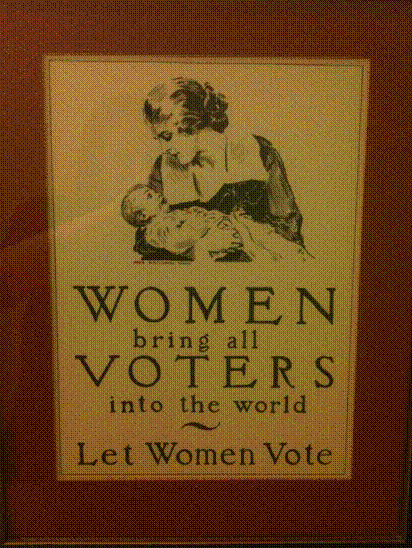
            An easy way to learn to spot rhetoric is to look at the pro-/anti- propaganda for something that feels obvious.  (Er...one hopes.)  For example, take a look at some of the posters supporting and opposing women's suffrage.
            The message of the first three is fairly simple:  women are supposed to be doing their work in the home, and giving them the right to vote will up-end that.  Suddenly, men will be saddled with all the baby feedings and the cleaning and so on.  I must admit, I rather like the second one; a pity having the right to vote doesn't mean I get to sit around eating chocolate and playing cards with my friends all the time!


            One of the things that feels obvious about these now — and that I think this next one particularly well illustrates — is that now the images feel grotesque in their literal role reversal.  The crude, almost oafish simplicity of the reversal makes you uncomfortable when you realize how natural the reverse of the images felt to the audience.  In other words, it felt totally appropriate to the anti-women's suffrage movement to simply place one of the women in the other room doing the washing, while there were three men sitting around playing cards.  (Presumably drinking beer rather than eating chocolate.  Beer if very masculine.)  I particularly enjoy "Husband's Working Hours 3 A.M. to 12 P.M."  Because those actually are most mothers' working hours.


            The message of all three is:  don't mess with the natural order of things.  If you do, women may very well take their revenge for all those years of oppression.


            This last one is interesting to me because of how complicated it is.  I think it's a valid point how many roles in society women were considered fit to serve in, while the vote was still denied to them.  And I like that "Mother" is included with "Doctor or Teacher."  On the other hand, the list of things "a Man may have been, & yet not lose the Vote" seems problematic.  "Unfit for Service"???  Seriously?  Because a guy is born with a congenital birth defect, or he's been injured in adulthood, his right to vote seemed questionable to these folks?
            And the one that says "Proprietor of white Slaves"...that one's interesting because it links up to a moral panic about "white slavery" — i.e., the kidnapping and forced prostitution of white women.  As it turns out, the panic was largely overwrought; there really weren't hundreds of women a year being forcibly dragged into prostitution.  The situation was tragic, but in a much different way.  There were hundreds, if not thousands, of young women moving to cities with no idea how to conduct themselves in a romantic or sexual relationship in a supposedly Brave New World.  Their parents were terrified a Jew or an Italian would seduce them into slavery, which was a red herring; what might have been useful was an actual education for young women on how to handle modern relationships.  But of course, their parents had no more knowledge about such things than they did.
            The scare over white slavery seems to have contributed to women getting the vote.  Suffragettes — many of them being mothers — were understandably scared about what they were hearing about their daughters in the cities.  They believed that getting the vote would empower them to put issues concerning sexual exploitation on the dockets of politicians.  It's interesting that a hysteria surrounding an only sort-of-real problem is part of what led to women's suffrage.


            The funny thing about a lot of the pro-women's suffrage propaganda is that it appeals to the same norms that are held up in the anti-women's suffrage propaganda.  They proclaim:  women want to do nothing but clean and make babies.  It's just that, politics do actually impact how we do those things, so we should get a say in politics.  The first two below actually affirm the proper place of women, and what kinds of work we should expect from them.  The message seems to be:  don't worry.  It won't be that bad.  Women will still take care of your kids!
            Of course it is true that politics do impact things related to women's work — everything from the ingredients in laundry detergent to breastfeeding in public to gun control laws — but because most of us feel like the statement "WOMAN'S JOB IS THE HOME!" is out of joint with our current time, the appeal feels off.


            The image below alludes to the white slavery panic I mentioned above.  It also uses a great image of a central female figure.  Yes, she's pushing for the right to vote, and that may seem to question the normal division of labor according to gender.  On the other hand, the figure, which is called "Womanhood," resembles a goddess or statue of an abstracted value — Liberty, say, or Justice — which is an interesting strategy.  It doesn't follow the lead of the above propaganda, which says, "Don't worry!  Women really want to stay home and have babies!  They just also want to vote."  It also doesn't suggest a wholly new way of looking at women (which would seem inappropriate; as voting wasn't new, agitating for women's suffrage was hardly a radical notion).  Instead, it reminds people that there are other narratives/images/archetypes for women within the context of the history of the West.


            This last one is just delightful.  Because they've simply adopted the rhetoric of the anti-women's suffrage movement to create a parody.  It does a nice job of showing how you can use language to argue just about anything.  Which is, again, Socrates'/Plato's definition of rhetoric.
            My particular favorite is number four:  "Because men will lose their charm if they step out of their natural sphere and interest themselves in other matters than feats of arms, uniforms and drums."
            Abso-fuckin'-lutely.  I might add soccer in there.  Or would that qualify under uniforms?


Monday, November 11, 2013

φιλοσοφἰα, γυνἠ, part two

Continued from an earlier post, on October 18th.


I'm spending awhile explaining where I'm coming from (in case that wasn't obvious from the aforementioned post). All of this is a very long-winded way of announcing that I am planning on moving into more explicitly philosophical territory. Philosophical, as I define it. I'm explaining my interest on a more personal level, because on the surface the term "Philosophy" comes off as specialized and, frankly, elitist. But the term, and the action of the heart and mind are, I think, very different.

            Philosophy is a word for something I originally turned to out of alone-lonely.  But then I got distracted from it by sex, and found a new kind of lonely:  I call it "man-lonely."  Lots of women know this lonely.  It's not so much wanting men, as it is the discovery that you don't get to choose either to be with them, or to escape them.  It's men who refuse to leave you alone, and even being a bitch just gets you followed around and yelled at for being a bitch.  (Trust me; I experimented.)  Alas, in my desperation to make the alone-loneliness stop, I mostly failed to be a bitch and went for super-sugary-sweet-and-nice and I held onto those assholes, goddammit.

            Fast-forward several years, and several miserable relationships later.  I am in a bookstore.  There's a book with a lovely cover.  It's called Philosophy, and I think to myself, "I remember when I used to like philosophy.  Before I dated men who like philosophy.  I remember when I thought I was smart.  Before I dated men who corrected me."  And I buy the book.  Mostly because the cover is nice, the layout looks like it's meant for laypeople, and the editor's name is pretty:  David Papineau.  The number of books I've purchased for similar reasons, and then never read, is huge; so I figure this one will have friends.

            One week after said book purchase:  I got in an accident.  My beloved Vespa betrayed me, crushed my foot, and removed a noticeable portion of my epidermis.  I was unable to walk for three months.  Suddenly, I had a lot of free time on my hands.  I couldn't fill it with work or men or anything.  Mostly I alternated between crying over my broken heart (I had also just been through [what I sincerely hope will be] the breakup to end all time), and crying from the physical pain I was in.  So what was I going to do with all my time?  I mean, I'm a champ when it comes to sobbing, but even I was getting tired of it.  Hobbling around on crutches was excruciating for reasons I won't go into due to the ick factor, so I basically had a forced three-month-long reading break.
            So there was this book.  And it was pretty.
            And I felt sick.  Sick from trying to crawl away from myself — from my own intellect and creativity — in an effort to be less intimidating to the men I was sure wanted to make me happy.  After all, they kept saying so!  "All I want is to make you happy and take care of you."  I'm pretty sure I thought that if only I could crawl fast enough away from myself, some guy would finally be able to give me all the love and happiness they kept promising.
            Which leads me to the second Greek word in the title of this post.

            γυνἠ: gunē.
Woman.
Because, finally, it is beginning to sink in: no human being can simply set aside their specificity in order to engage with the upper echelons of creative and intellectual achievement. I used to believe such non-specificity was possible. As a German-American who grew up surrounded by Jews, I was desperate for non-specificity. As a white girl who briefly lived in a part of California where I was one of the only white kids, I've been shocked to discover that most white Americans don't grow up with nearly the ethnic consciousness I always had. If you are one of those white Americans, I guess you're lucky. I guess that's what we mean when we talk about privilege.
When I was at university, and anti-feminists insisted that anyone was welcome to the philosophical tradition, that anyone could engage with the Western literary canon, everyone was welcome, it was an open book available to all, if only those women/blacks/Jews/gays/Latinos/whoever would stop whining about their differences for long enough to engage with the tradition, we could all realize how much we all had in common — I wanted to believe them so badly. I did believe them. I chimed right in.
But when I was finally angry enough at the way men had treated me, angry enough at the story of boy meets girl, boy loves girl, and they get married and he takes care of her for the rest of her life, when I was finally angry enough to have not only been lied to, but to have helped build the lie, when I was finally angry enough to push back, I can tell you specificity still mattered.

So here we are. For the past year or so, I've been reading Plato. Almost nothing but Plato. And, um, why is this blog here? Oh, yeah. It was supposed to be a space for me to think out loud about what I was reading. But honestly, I haven't been thinking out loud about a lot of what I'm reading, because I keep having all these thoughts that seem — *ahem* — specific. They are specific to being a woman, and specific to a post-colonial historical moment. They are specific to being a German-Scottish-French-American, and therefore both supposedly part of the tradition by ethnic descent, and awkwardly insecure about where our rebellious, anti-aristocracy, money-obsessed colony fits in with that tradition. And maybe more than anything else, my thoughts are specific to being an uncomfortable-yet-still-devout Christian, which is so incredibly out of fashion in philosophical circles as to silence all but the most confident (or naïve) thinker and writer.
Nothing I'm saying here is exactly new. Feminists and queer theorists, at the very least, have been saying it for at least a hundred years. But after all the miserable relationships, and confused and confusing teachers, all the Hollywood movies I believed without knowing I believed them, something even better than the bookstore happened: I suddenly found several men in my life who are probably better feminists than I am. They seemed to believe in the value of my thoughts and creativity, and also (to my surprise) were pretty sure I should be pissed off at having been silenced in so many ways, some subtle, some not so much. Like, spitting venomous, fire-breathing unicorns kind of pissed off. Maybe I should have been able to get there on my own. Maybe I should have been inspired by a feminist or two. (Okay. Maybe one. Or two.) But however it happened, it happened. I got lucky. I found out that the issue with men and women in this world isn't that men are mean and women are pure and innocent victims. It's much more complicated and difficult and interesting than that.
So while it's true that nothing I'm saying here is entirely new, I think I got tired of not saying it, in my own words.